At first glance, the ledges can look like another stretch of exposed shoreline rock. Slow down and look closer, though, and fossil shapes and fragments start appearing in the limestone.
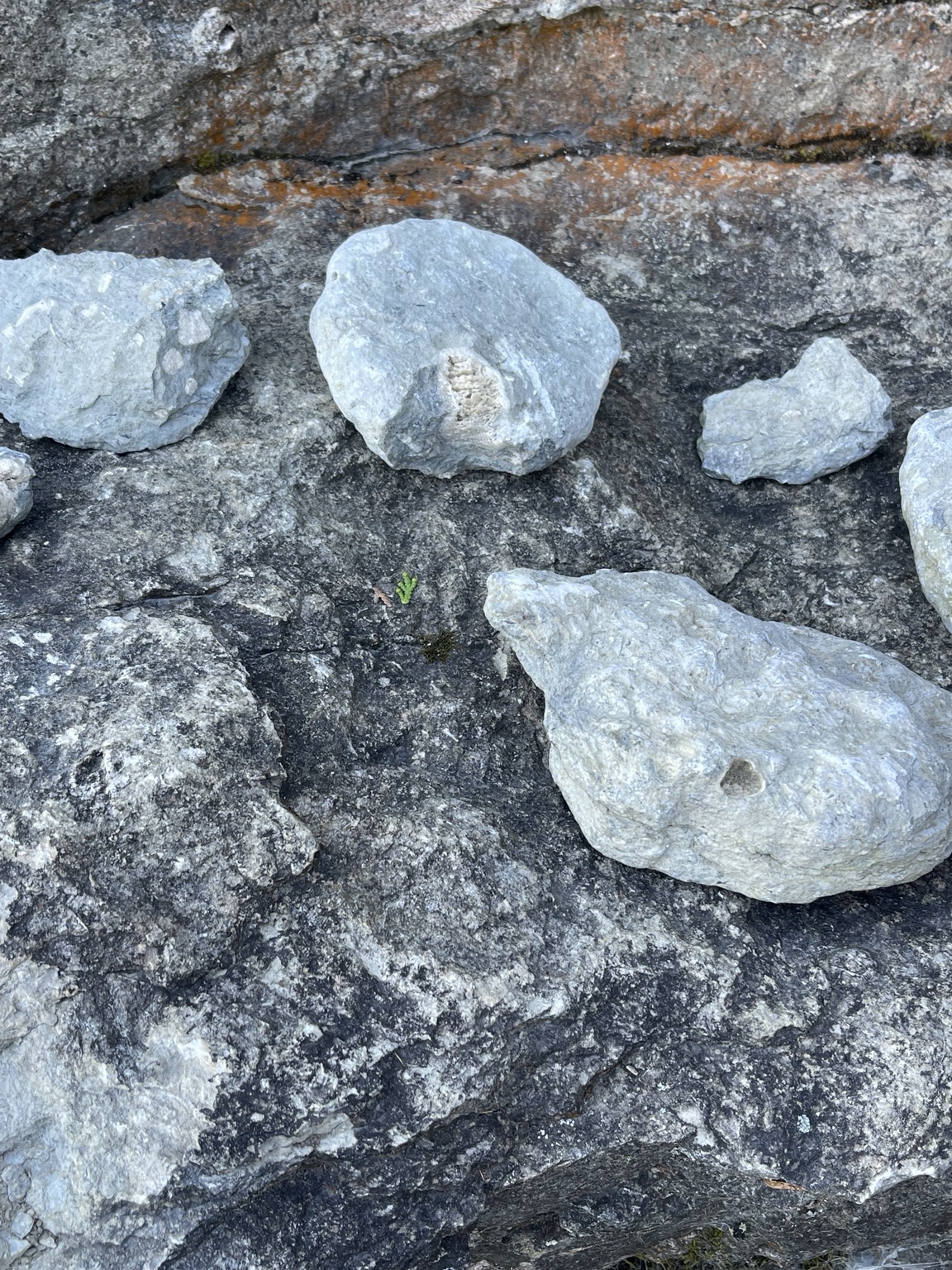
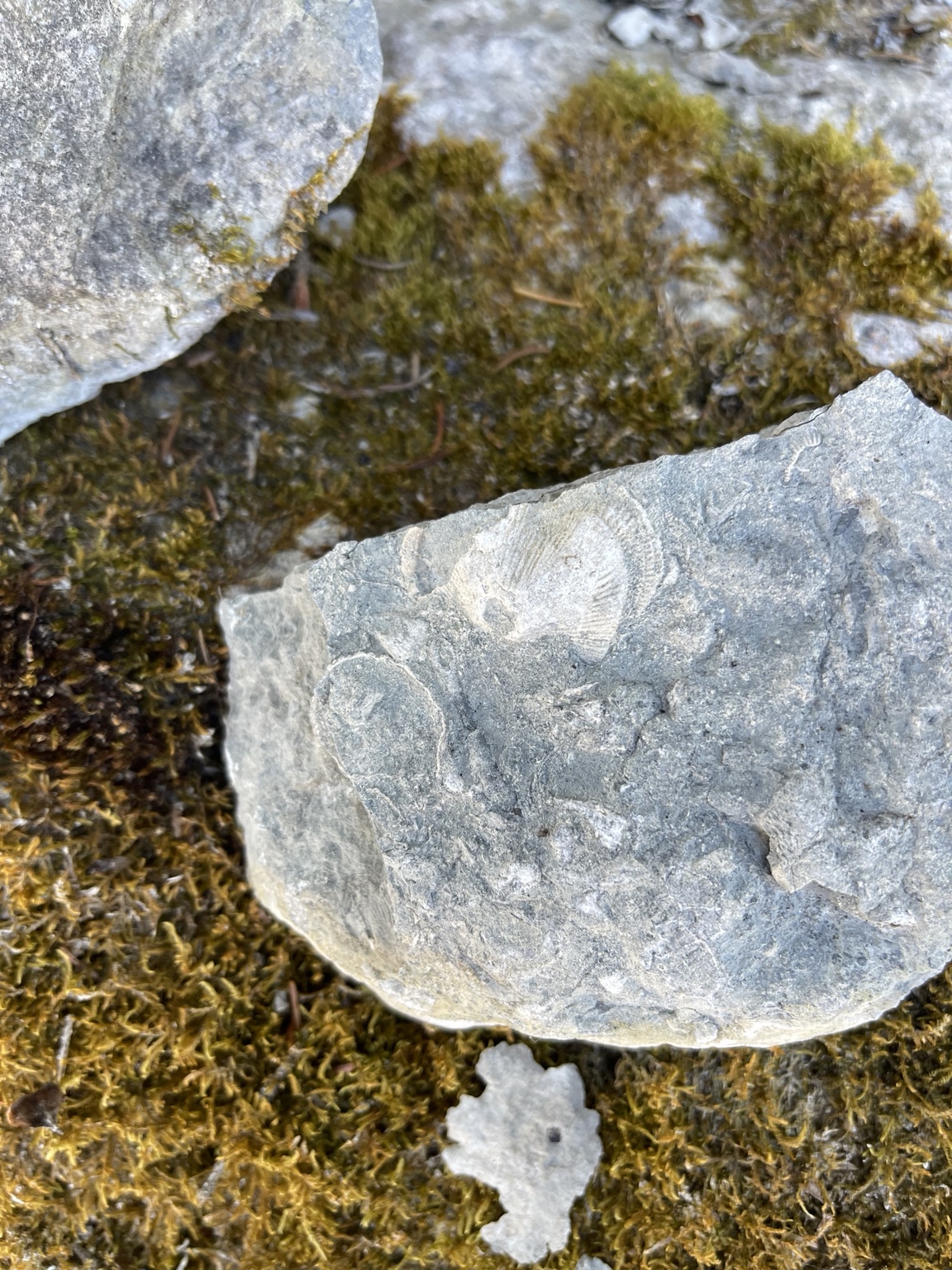
Some are embedded directly in the ledges. Others are visible in loose, wave-worn stones along the shore. Individual fossils should be identified cautiously without expert review, but the larger story is clear: this rock formed in an ancient marine environment.
You don’t really hike to Fossil Ledges. You drive your way there.
I’ve made the trip twice. The first time, I used a four-wheel-drive Chevrolet Colorado. The second time, I went in a side-by-side. Both trips meant traveling the kind of rough Drummond Island roads where ground clearance matters and the drive becomes part of the adventure.
Then, after all those miles, you reach the small parking area, walk about 10 or 15 steps through the trees, and suddenly you’re standing on a fossil-bearing Lake Huron shoreline.
The contrast is almost funny. The drive is long and rough. The final walk is practically nothing. And what’s waiting at the end may preserve part of an ancient marine reef more than 440 million years old.
A Different Kind of Drummond Island Shoreline
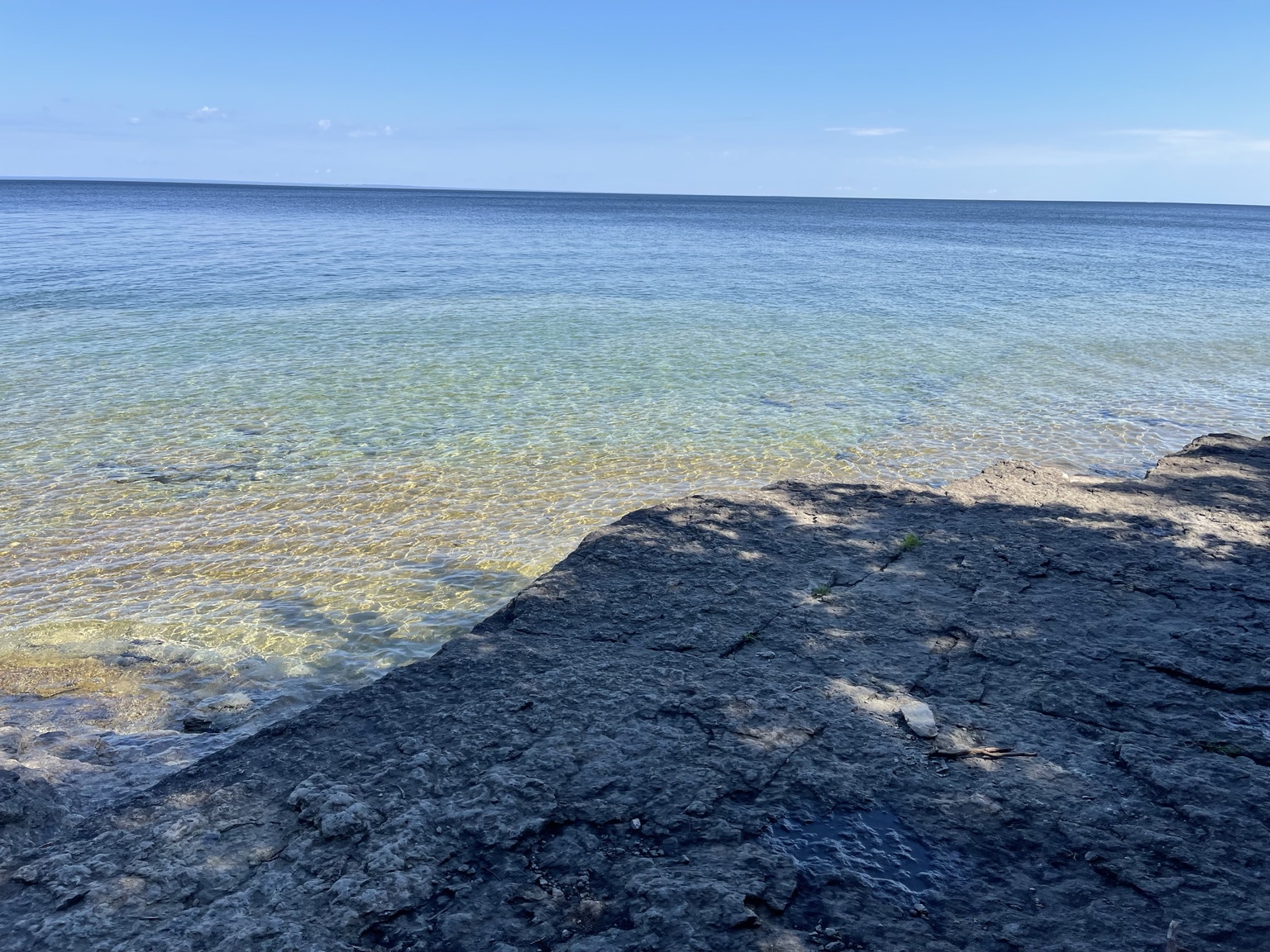
Fossil Ledges lies along the northern shoreline of Drummond Island, west of Raynolds Bay. The site consists of broad, nearly horizontal limestone shelves extending along Lake Huron.
At first glance, the ledges can look like another stretch of exposed shoreline rock. Slow down and look closer, though, and fossil shapes and fragments start appearing in the limestone.
Some are embedded directly in the ledges. Others are visible in loose, wave-worn stones along the shore. Individual fossils should be identified cautiously without expert review, but the larger story is clear: this rock formed in an ancient marine environment.
The shoreline is wide open and largely undeveloped, with the forest meeting the limestone shelves. Cracks, uneven edges, shallow depressions, and wet surfaces make it an interesting place to explore, but this isn’t a smooth or accessible walking path.
On my first trip, I saw other visitors. When I returned early on a weekday, I had the place to myself. That quiet second visit was a great experience, but it doesn’t mean Fossil Ledges is always empty or undiscovered.
Is Fossil Ledges Really a Coral Reef?
Fossil Ledges is commonly described as an ancient coral reef, and some modern descriptions identify it as Silurian in age. The strongest geological evidence tied specifically to this location points in a different direction.
A 1952 Michigan Geological Survey report documented what it called a “Great Stromatocerium reef” three-quarters of a mile west of Raynolds Bay. That location closely matches the modern Fossil Ledges attraction.
Because the report examined Michigan’s Middle and Upper Ordovician rocks, the evidence strongly suggests that Fossil Ledges may be a Late Ordovician reef exposure rather than a Silurian one. If that identification is confirmed, the reef is more than 440 million years old.
The match is compelling, but it isn’t completely settled. The 1952 report doesn’t use the modern name Fossil Ledges, and a current geologist hasn’t explicitly matched today’s coordinates with that historic exposure.
For now, the safest conclusion is that the best site-specific evidence points toward a Late Ordovician reef, but modern geological confirmation is still needed.
The word coral also tells only part of the story. Stromatoporoids were extinct, sponge-like reef-building organisms rather than true corals. Corals and other marine organisms were also likely part of the ancient community.
Calling Fossil Ledges an ancient marine reef is therefore more accurate than describing it as something built entirely by coral.
The Road Is the Real Hike
Reaching Drummond Island starts with the vehicle ferry from DeTour Village. The crossing normally takes about ten minutes, but travelers should check the current EUPTA schedule and operating conditions before leaving.
Once you’re on the island, published local directions estimate the Fossil Ledges route at approximately 15 miles from Four Corners. The Drummond Island Tourism Association also estimates about 45 minutes of travel from the Maxton Plains signs, depending on road conditions.
Those conditions really matter. A high-clearance vehicle is strongly recommended. Four-wheel drive may be advisable, especially after rain or snowmelt, but it doesn’t guarantee that the route will be passable.
I made one trip in a four-wheel-drive pickup and another in a side-by-side. Those vehicles worked during my visits, but nobody should assume the complete route is legally open to every ORV. Road designations, permits, vehicle restrictions, and closures should be verified before traveling.
Township material identifies the destination as state land, but nearby private property makes staying on the established approach important. Don’t treat an unfamiliar track or apparent shortcut as public access.
After the long drive, the final walk is remarkably short. Current local guidance places the shoreline about 35 feet from the parking area, which fits my estimate of roughly 10 or 15 steps.
The approach may be short, but the ledges themselves are uneven, cracked, and potentially slippery when wet. Watch your footing around loose stone, depressions in the rock, and the edge of the lake.
Take Pictures, Not Fossils
When I visited, I photographed the fossils and left them where they were. I wasn’t completely sure what the collecting rules allowed, and leaving everything in place turned out to be the right decision.
Current Drummond Island Tourism Association guidance asks visitors to look without removing fossils and to take photographs instead of souvenirs.
Michigan’s general collecting limits for some state-owned and public-trust land don’t create automatic permission to collect at every destination. At Fossil Ledges, visitors should leave embedded fossils and loose stones in place. Don’t chip, pry, hammer, or carry material away.
That matters because the fossils are the attraction. Every piece removed makes the experience a little poorer for the next person who completes the long drive to see them.
Photographs can still show the variety in the limestone without damaging the site. Unless a qualified geologist or paleontologist reviews an individual image, captions should remain general, using descriptions such as fossil-bearing limestone, possible shell molds, or probable colonial reef material.
A Long Drive Into Deep Time
Fossil Ledges is one of those places where the journey and destination feel completely out of proportion.
You cross to Drummond Island by ferry, work your way along miles of rough road, and wonder what conditions might be waiting around the next bend. Then you park, take a handful of steps through the trees, and emerge onto a shoreline preserving an ancient sea.
The geology still holds an unresolved question. The familiar Silurian coral-reef description may be too simple or possibly wrong for this exact location. The strongest evidence instead points toward a Late Ordovician marine reef built by a community that likely included stromatoporoids, corals, and other organisms.
That uncertainty doesn’t weaken the story. It makes Fossil Ledges even more interesting.
The rocks are still there for scientists to study and visitors to experience because people have left them in place. That’s how Fossil Ledges should remain: explored carefully, photographed closely, and carried home only in memory.
More Photos
Comments (0)
No comments yet. Be the first to join the conversation.



Comments (0)
No comments yet. Be the first to join the conversation.
Log in to leave a comment, or register for an account.