I’ve been to Fiborn several times, and it’s still one of the coolest historic places I’ve explored in the Upper Peninsula.
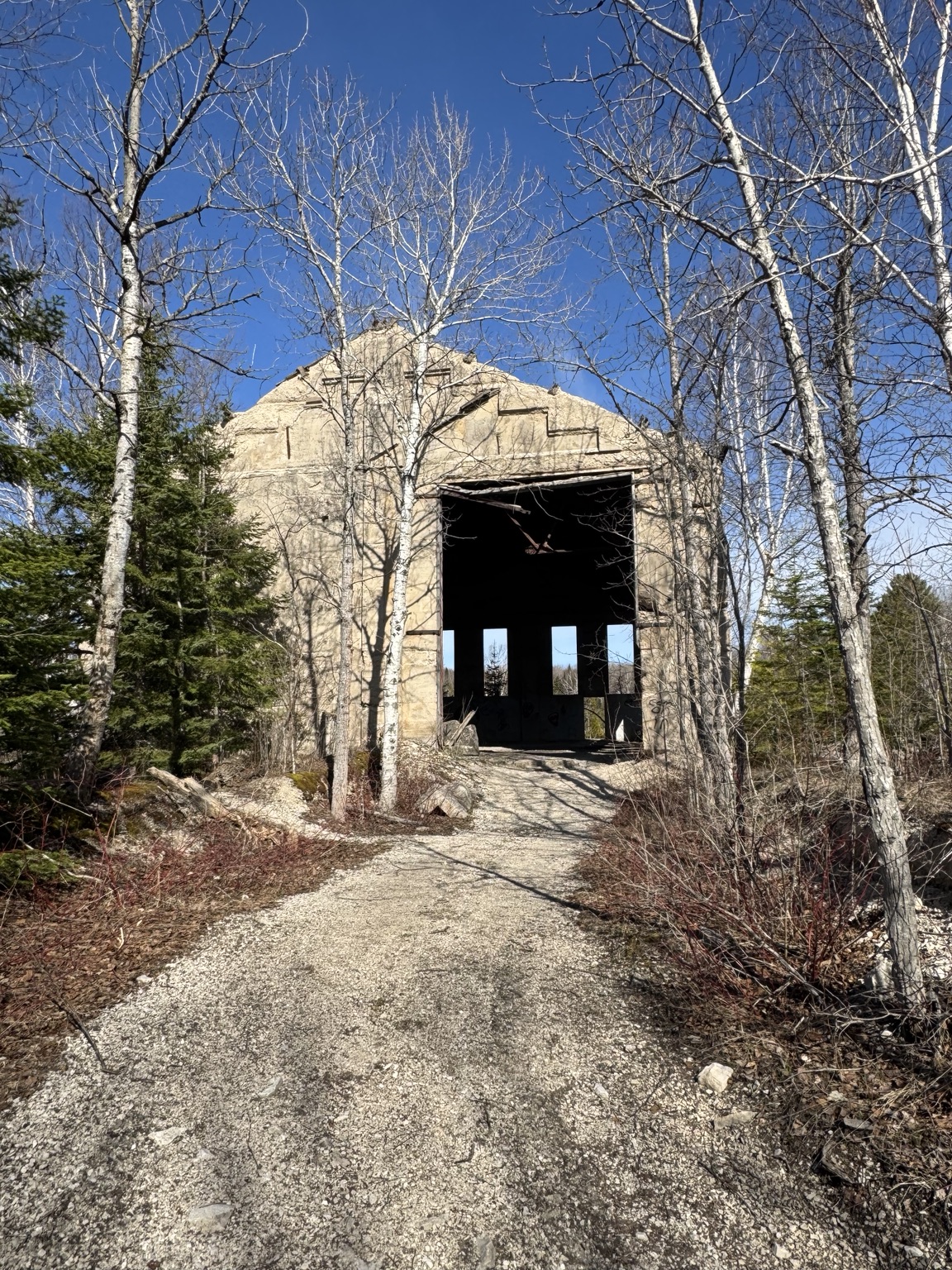
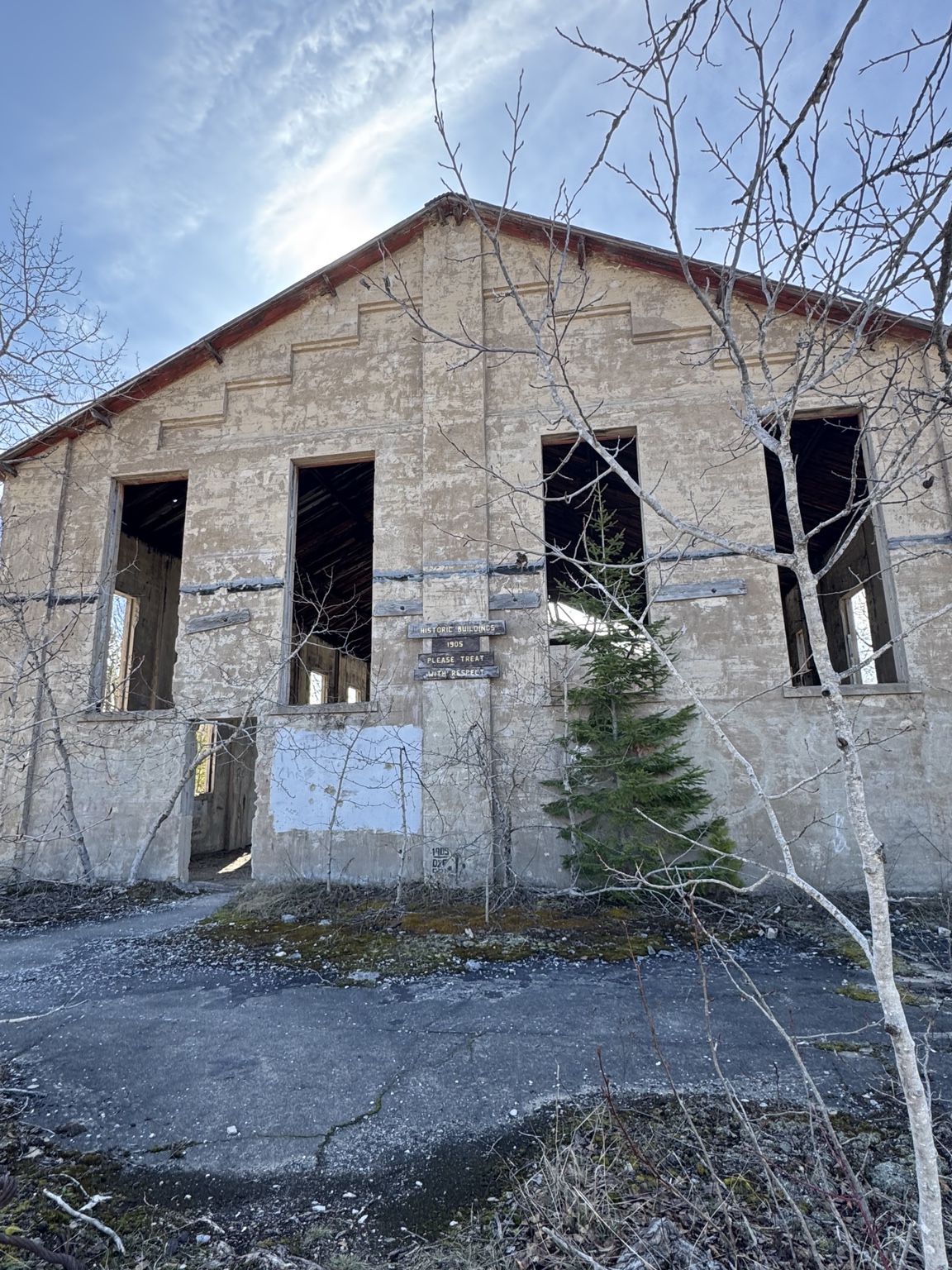
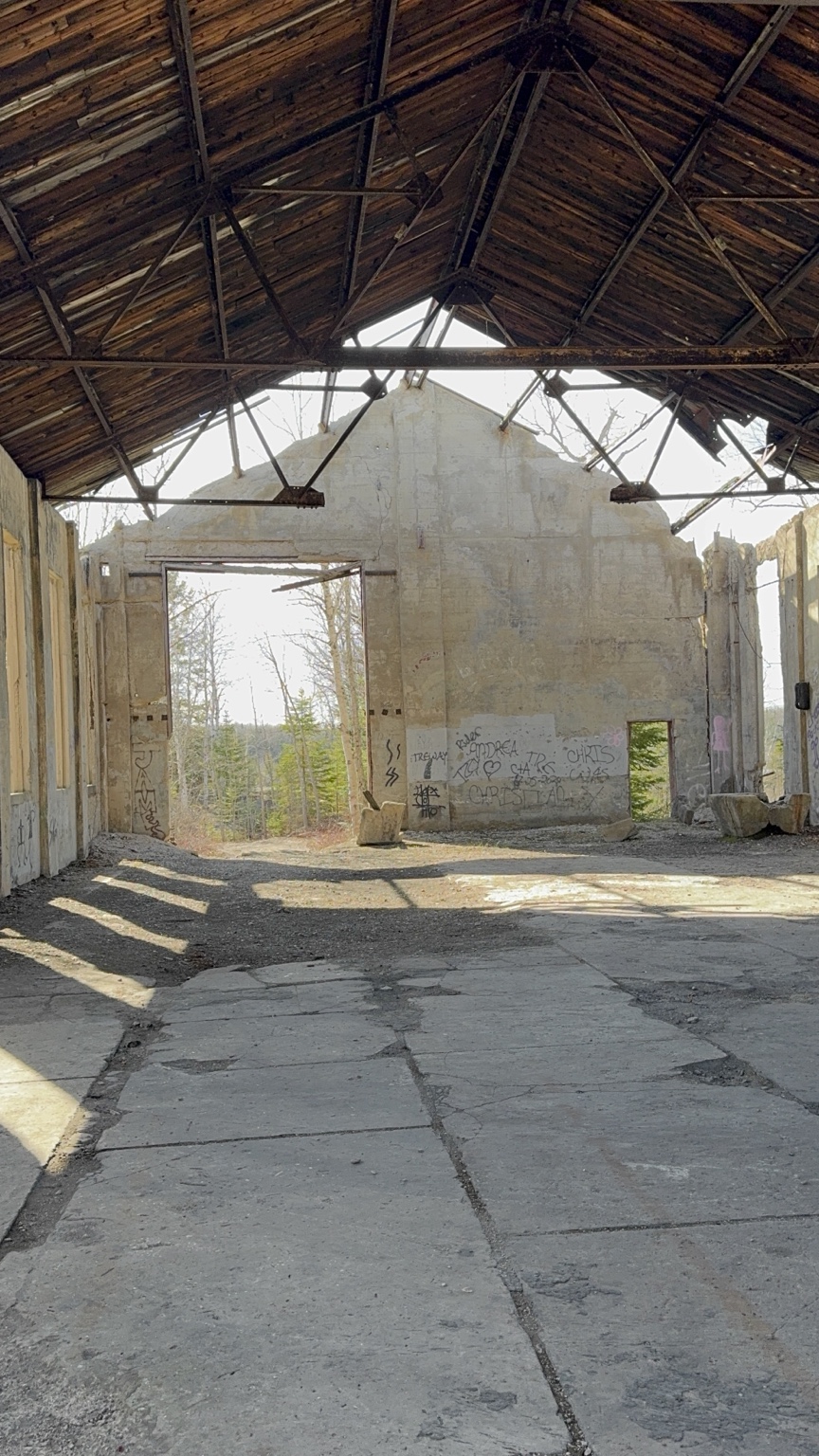
The railroad house is usually what grabs your attention first. Its tall concrete walls are still standing, with open windows, wide doorways, exposed roof framing, and plenty of graffiti. More than a century ago, small locomotives were stored and maintained inside. Today, it’s the biggest reminder that this was once far more than a hole in the ground.
I’ve been to Fiborn several times, and it’s still one of the coolest historic places I’ve explored in the Upper Peninsula.
The railroad house is usually what grabs your attention first. Its tall concrete walls are still standing, with open windows, wide doorways, exposed roof framing, and plenty of graffiti. More than a century ago, small locomotives were stored and maintained inside. Today, it’s the biggest reminder that this was once far more than a hole in the ground.
Across the preserve, you’ll find the remains of an industrial operation, the foundations of a company village, and a landscape shaped by the same limestone that brought workers here in the first place.
What surprised me most was learning why it all ended. Fiborn Quarry didn’t close because it ran out of limestone. It closed because the business of moving stone had changed.
The Men Behind Fiborn
Development and initial quarrying began late in 1904, with regular operations underway in early 1905. Chase Osborn and William Foresman Fitch promoted the quarry property. Fitch was president of the Duluth, South Shore and Atlantic Railway, an important connection for an operation that depended on rail transportation.
The name Fiborn is generally understood to combine parts of their surnames, Fitch and Osborn.
The quarry produced high-calcium limestone used mainly in steelmaking, along with smaller quantities for other industrial and road-building uses. Workers blasted the stone, and then steam shovels loaded it into quarry cars. Small locomotives moved those cars through the site, where crushers and sorting equipment prepared the limestone for shipment. A railroad spur connected the quarry to the larger rail network.
Knowing that gives the surviving railroad house a lot more meaning. It wasn’t a store, factory, or community hall. It was where the quarry locomotives were kept and maintained.
A Village Built Around the Quarry
Fiborn became more than a worksite. It grew into a company village with housing, a boarding house, a school, a company store, a post office, and places for the community to gather.
The foundations scattered around the preserve aren’t just pieces of an old industrial complex. They mark a place where workers and their families once went about their everyday lives alongside the quarry.
Algoma Steel acquired Fiborn in stages, beginning around late 1909 and continuing with another purchase in January 1913. After Algoma became involved, the quarry supplied the Canadian steelmaker almost exclusively. Production increased during World War I, weakened afterward, recovered through much of the 1920s, and declined again during the Great Depression.
The work could be dangerous. According to the Michigan Karst Conservancy’s historical record, two workers died in a dynamite explosion in 1910. A boiler explosion killed another worker in 1911. Their deaths are a sobering part of Fiborn’s story and a reminder of the human cost behind all the stone shipped from here.
Why Fiborn Closed
Fiborn permanently closed in January 1936, but its limestone deposit hadn’t been exhausted.
Algoma could obtain stone from Rogers City and move it more cheaply by water. Continuing at Fiborn also would have required costly modernization. The quality of its limestone was no longer enough to make up for the expense of producing and transporting it.
When the quarry closed, the reason for the company village disappeared with it. Fiborn emptied quickly, although it wasn’t abandoned in a single day. Limited quarrying and the removal of equipment continued after the main operation shut down.
That ending may not sound especially dramatic, but it’s one of the most interesting parts of the story. Nothing had to happen to the limestone. A change in transportation and industrial costs was enough to bring down the operation and the community built around it.
What Remains Today
Fiborn is now a privately owned preserve managed by the nonprofit Michigan Karst Conservancy. It isn’t a state park. The conservancy purchased 480 acres of the former quarry and adjoining property in 1987.
There’s a lot to see if you slow down and look at how the pieces fit together. Along with the railroad house, the preserve contains the remains of the ore-car loading works, industrial and village foundations, the quarry floor, limestone walls, and Fiborn Pond.
Some remains are obvious. Others are easy to walk right past without realizing what they are. Together, they show both sides of Fiborn: the industrial operation and the community that depended on it.
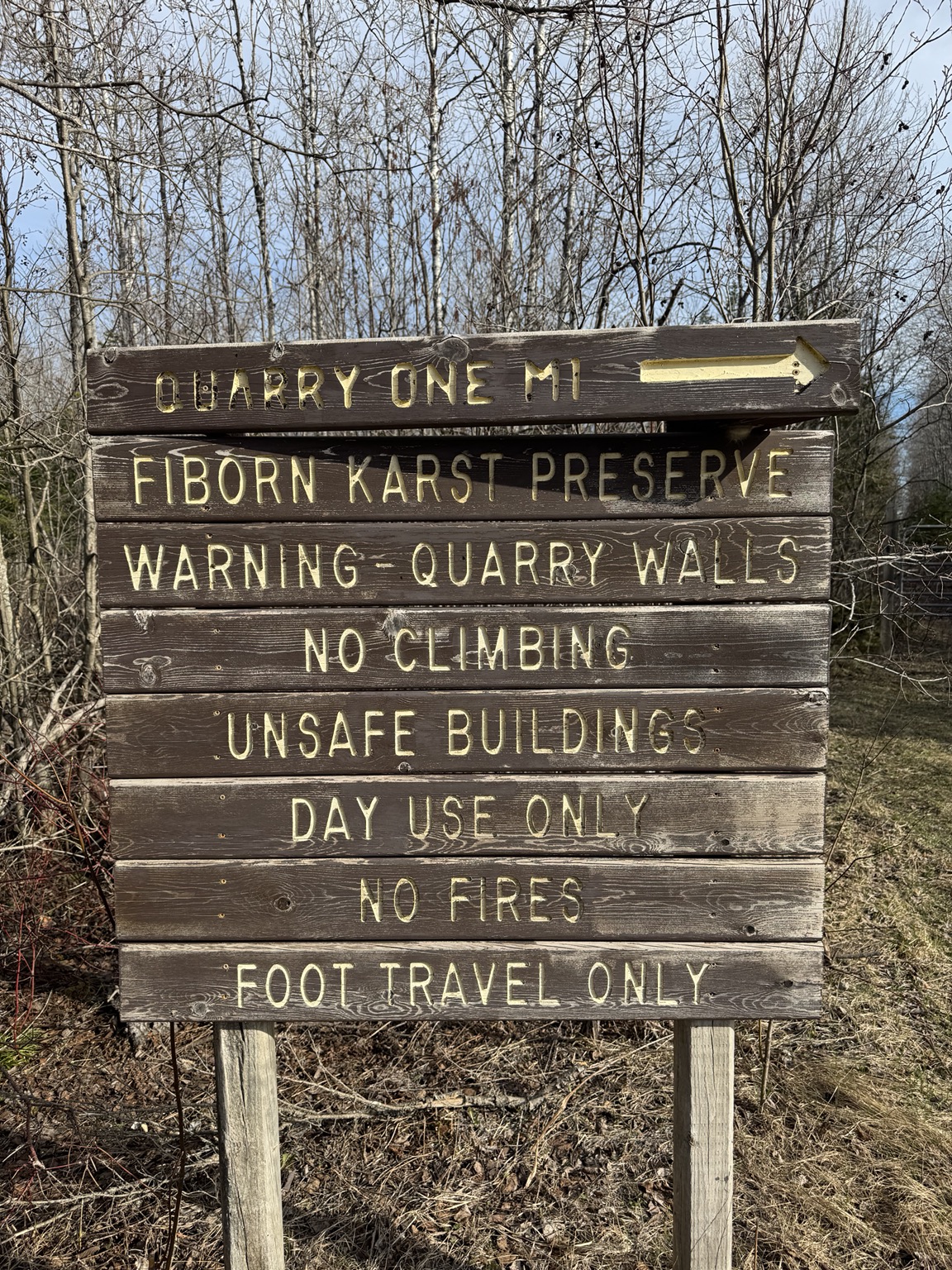
The graffiti inside the railroad house is impossible to miss, but it isn’t part of Fiborn’s historic story. Posted signs identify the buildings as unsafe. Visitors shouldn’t climb on the ruins, enter unsafe structures, or add to the damage.
The Landscape Beneath the Ruins
The quarry is only one layer of Fiborn. The preserve also protects an active karst landscape with sinkholes, disappearing streams, springs, earth cracks, and caves.
Karst develops as water moves through soluble rock such as limestone, creating underground drainage and openings. At Fiborn, the geology that once made the land valuable to industry is also what makes the preserve so unusual today.
The Michigan Karst Conservancy identifies Hendrie River Water Cave as Michigan’s longest known cave, with roughly 1,500 feet of passage. This isn’t an open, walk-in attraction. Entry requires advance written permission and proper equipment, and the cave closes seasonally to protect bats.
Visitors shouldn’t search for an entrance or attempt to explore the cave without authorization. It’s part of a sensitive natural system, not another abandoned structure to wander through.
Planning a Visit
Fiborn Karst Preserve is in Mackinac County near Trout Lake. Two self-guided trails are available, including the approximately 1.5-mile Barbara Ann Patrie Memorial Trail.
These aren’t smooth park paths. Conditions may be rocky, muddy, wet, narrow, steep, or uneven. The preserve is normally unstaffed, and cell service may be limited. Roads, parking conditions, and tour availability can change, so check the Michigan Karst Conservancy’s current information before making the trip.
Follow every posted restriction while visiting. The signs warn that the buildings are unsafe and prohibit climbing on the quarry walls. An open doorway doesn’t mean a structure is safe to enter.
Fiborn is worth more than one visit. The railroad house may grab your attention first, but the real story is spread across the preserve in old foundations, industrial remains, quarry walls, and the limestone beneath it all.
The quarry didn’t disappear because the stone was gone. The stone is still there, shaping the land and holding the remains of the community that once depended on it.
More Photos
Comments (0)
No comments yet. Be the first to join the conversation.

Comments (0)
No comments yet. Be the first to join the conversation.
Log in to leave a comment, or register for an account.